| How
to make Dry Rot Repairs | |||
| We are a National Service - with local Specialist Surveyors | |||
| How to repair Dry Rot | |
|
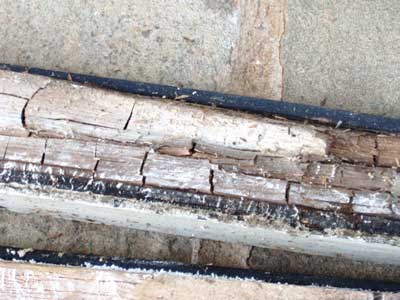
1. Drill to establish extent and cut back to sound timber. Eliminate the source of moisture. 2. For Holes and Voids - fill with Moulding Mortar, a putty like non shrink epoxy, (if not more than 30% of cross section lost, subject to survey). 3. For Missing Ends or Mid Spans - fit a made to measure Timber-Resin Splice - price by E Mail, Fax:01626 331343 or Tel: 01626 331351, with free of charge Design, Method Statement and List of Materials and Tools. For more Technical Information and a Photo Gallery go to:www.timber.org.uk Timber-Resin Splice end unit fitted | ![]() |
| Example | |
| Bindon House Hotel - the roof tie beams were badly affected by Death Watch Beetle, Wet Rot and Dry Rot. These were replaced with TYPE E Timber-Resin Splice Units and timbers like these should be treated with Boron Ultra 12 by spray, Boron Ultra Gel to end grain and vulnerable surfaces and Boron Ultra Paste by injection. Bindon House after restoration | ![]() |
| How to treat and eradicate Dry Rot | |
|
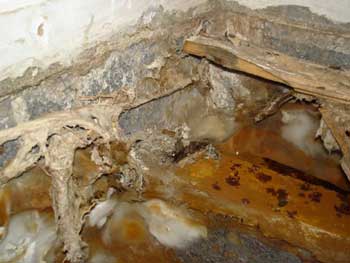
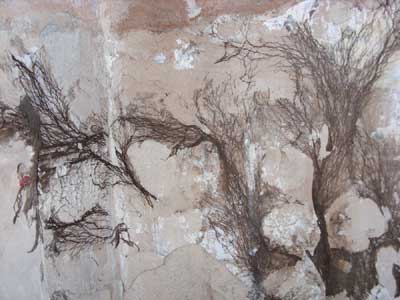
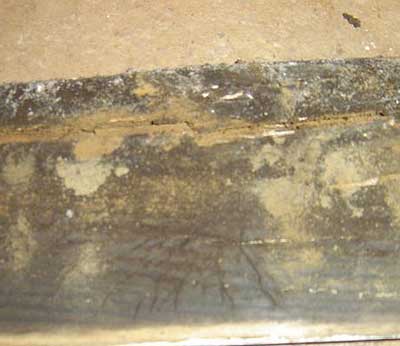
1. Eliminate the moisture source and establish the extent by drill testing 2. Remove all decay back to sound timber.(Note - no need to cut back and scrap good wood)) 3. Inject Boron Ultra Paste, apply Boron Gel and surface spray/brush with powder in water Boron Ultra 12. Dry Rot rampant on an office wall | ![]() |
| Example | |
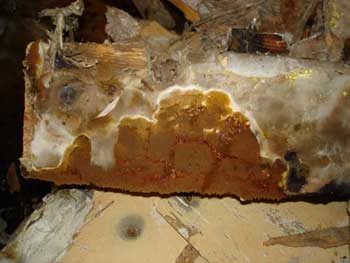
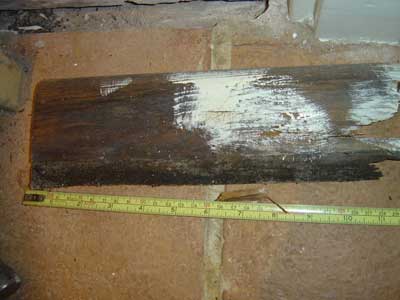
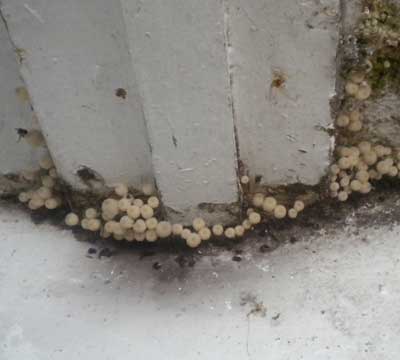
| Manor House, Warwick - extensive infestation had resulted in massive areas of Dry Rot mycelium (skin) and sporophores (fruiting bodies - mushrooms) on timber and masonry. Previous treatments with conventional chemicals had failed to stop the spread of fungi. Boron Ultra 12 powder in water was applied by spray to timber, masonry and sub-sites, Boron Ultra Gel to end grain and vulnerable surfaces, Boron Ultra Paste and Boron Ultra Rods to 8-10mm holes drilled to prescribed hole pattern, to surrounding areas at least 300mm in all directions from the limits of the attack and to all timbers at or above 18% moisture content. Fruiting Body of Dry Rot - note the red spore dust | ![]() |
| How to prevent Dry Rot | |
|
1. Prevent the ingress of moisture by eliminating penetrating and rising dampness 2. Treat vulnerable timbers (those above 18% moisture content) and those subject to seasonal dampness (e.g. window and door frames, wall plates) with Boron Ultra Rods, Boron Paste and Boron Gel. To prevent surface spread apply Dry Rot Paint, an emulsion that can be applied to timber and masonry. BRE testing proves that Dry Rot will not 'walk across' surfaces coated with this paint. 3. To avoid leaving timbers that are drying out vulnerable to Dry Rot, cut back wet rot damage and dry out/treat as above The Log House - before restoration | ![]() |
| Example | |
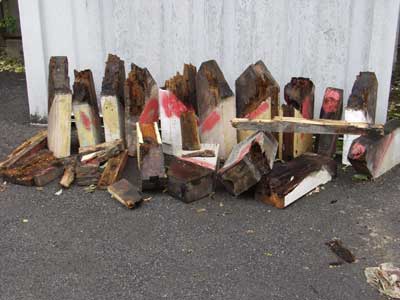
| The Log House, near Lymington - wet rot decay had destroyed a large number of logs on the weather side of this £1.5 million + home, facing Southampton Water. This left the damp timbers vulnerable to Dry Rot, so Boron Ultra Paste and Boron Rods were installed in the remaining sound logs to provide long term protection. Digging out the rot - we make replacement logs, voids are filled with Structural Epoxy Pouring Grout For more Technical Information and a Photo Gallery go to:www.timber.org.uk WOOD PRESERVATIVE AND BIOCIDE SAFETY Use wood preservatives and biocides safely. Always read the label and product information Data Sheet before use. Wear the correct safety equipment and keep unprotected people and animals out of the treated area for the statutory period given on the label. All products have some hazards and the COSHH Regulations (Control of Substances Hazardous to Health) apply to ALL building repair and construction products that we sell, even Cement. If
in doubt consult us for free technical help. Take care not to contaminate soil,
waterways or the environment with the product or the waste and packaging. |
Property
Repair Systems |